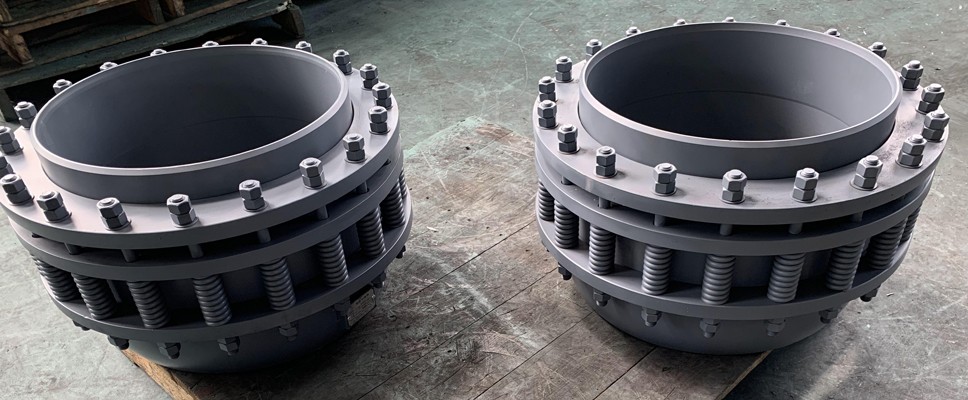
Maintenance-Free Rotary Compensator for Thermal Pipelines
A spring-loaded rotary compensator that automatically compensates packing wear—delivering 5000 leak-free cycles at 4.0 MPa and eliminating frequent shutdowns for seal repair on thermal pipelines.
Maintenance-Free Rotary Compensator
The Seal That Maintains Itself—So Your Pipeline Doesn't Have To Shut Down
Every rotary compensator relies on flexible packing to seal the rotating joint. The difference is what happens after thousands of rotation cycles, when that packing begins to wear. Conventional designs require periodic shutdowns to re-tighten or replace the gland. This maintenance-free rotary compensator solves the problem at the source: a spring assembly above the packing gland continuously applies compensating tension, automatically taking up wear before it becomes a leak.
The result is a compensator that extends its own leak-free service interval—dramatically reducing shutdown frequency and maintenance workload for district heating and thermal pipeline operators.
How It Works
The core structure comprises a reducer pipe, inner sleeve, sealing seat outer sleeve, flexible graphite packing, bolt-and-spring gland assembly, packing gland, and precision balls. These components work together to form a rotation-based sealing system:
The flexible graphite packing inside the sealing chamber provides the primary seal against the rotating inner sleeve.
Precision balls maintain concentricity between the rotating and stationary parts, ensuring smooth rotation without eccentric binding.
The spring-loaded gland assembly is the key differentiator: when the graphite packing experiences minor wear, the spring tension automatically advances the gland to compensate—extending the time before any leakage occurs and eliminating the need for frequent manual re-tightening.
Performance Advantages
Verified Leak-Free Performance
Tested to 5000 compensation cycles at 4.0 MPa without leakage. The spring-compensating mechanism maintains sealing pressure throughout the wear cycle, ensuring stable performance on thermal networks where pressure and temperature fluctuate.
No Frequent Shutdowns for Seal Repair
Because the spring automatically compensates for packing wear, operators avoid the repeated gas-supply interruptions associated with conventional compensators. For both supply utilities and end users, this translates directly into higher social and economic benefit—less lost steam, fewer production interruptions, lower operating cost.
Flexible Graphite Packing—Sealing and Maintenance-Free in One
The selected flexible graphite packing combines excellent sealing performance with self-lubricating, maintenance-free characteristics. It withstands high temperature, resists chemical attack, and requires no routine replenishment under normal operating conditions—reducing both maintenance cost and maintenance difficulty.
Economic and Operational Benefits
Higher pipeline operating efficiency — fewer shutdowns mean more available transmission capacity and lower production cost.
Reduced leakage risk — superior sealing performance lowers accident risk and improves production safety.
Lower maintenance workload — the maintenance-free design cuts inspection and repair labor, further improving economic returns.
Environmental Contribution
By reducing leakage incidents, the compensator lowers the risk of environmental contamination from escaping media. Its efficient, stable operation also contributes to lower energy consumption and emissions, aligning with green development requirements for modern thermal networks.
Summary
The maintenance-free rotary compensator combines a proven rotation-based sealing structure with a spring-compensating gland that manages its own wear. For thermal pipeline operators, that means fewer shutdowns, lower maintenance cost, verified leak-free performance at 4.0 MPa, and a longer service interval—a design that continues to prove its value as industrial thermal networks expand.
Send us your pipeline parameters—diameter, design pressure, design temperature, medium, and connection type—for a dimensional drawing and quotation.
INQUIRY


CATEGORIES
LATEST NEWS

CONTACT US
Contact: Cissy Peng
Phone: 86-13989717939
E-mail: sales@forobellows.com
Whatsapp:86-13989717939
Add: Louzhuang Town, Jiangyan City, Jiangsu Province